
Buncombe County Court Records After Arrest
After a Buncombe County jail arrest, two record tracks can exist at the same time. The first is the jail or booking record created by the Buncombe County Sheriff's Office when a person is received at the Buncombe County Detention Facility. The second is the court record maintained by the North Carolina Judicial Branch and the Clerk of Superior Court after a criminal case is opened. The two records often use similar words, such as charge, bond, and status, but they do not serve the same role.
The District Attorney for Prosecutorial District 40 prosecutes Buncombe County criminal cases. The official district attorney page listed Todd Williams during the research period, and it describes the office as the public prosecutor for criminal cases filed in the district. That matters because booking charges shown through jail tools can later be amended, reduced, dismissed, or replaced by prosecutor-filed charges. For custody, booking, or jail roster detail, use Buncombe County jail inmate records. For booking photos and P2C Recent Arrests context, use Buncombe County jail mugshots. Court records after a jail arrest belong in eCourts, the Clerk's office, and public court terminals.
Find Buncombe County Court Records
The main online search path is the North Carolina eCourts Portal. The Judicial Branch says the Portal provides public case information, hearing searches, judgment search, and payment functions. Anonymous public search is available, while registration mainly helps users save cases. Elevated access is limited to authorized users, so a public search may show less than a clerk or authorized court user can see.
The Buncombe County courthouse page and court contact directory route users to the Clerk of Superior Court and related court offices. The courthouse main number is (828) 259-3400. Judicial Branch guidance also says criminal cases can be viewed from public, self-service terminals in a clerk's office in any county, and paper files can be accessed in the clerk's office where the case is located.
The NC eCourts Portal is the source shown in the court-search screenshot below.
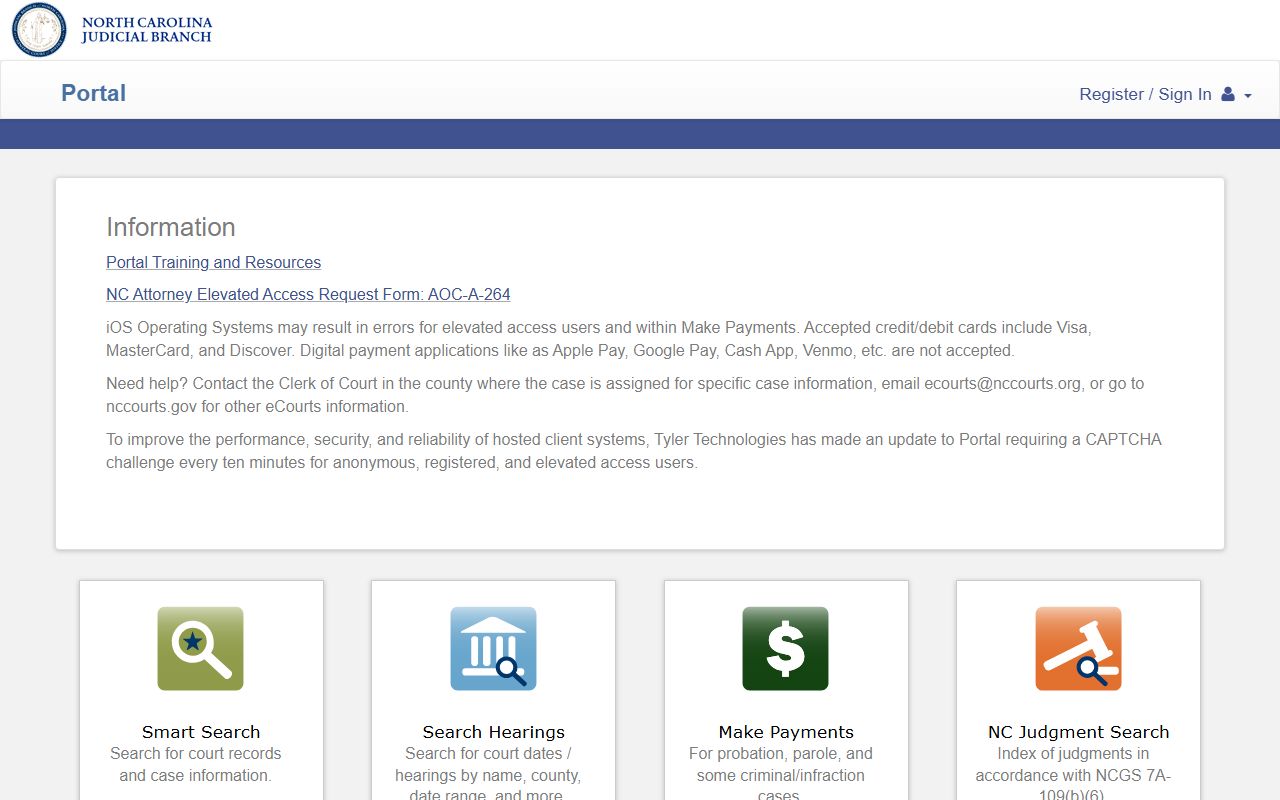
Use Portal results as a public index, then confirm unclear or incomplete details with the Clerk of Superior Court when the case file controls the answer.
| Field Label | Type | Required | Notes |
|---|---|---|---|
| Smart Search | Text | Yes for search | Searches public case information. |
| Location | Filter | No | Use Buncombe County or the court location when available. |
| Party name | Text | No | Can be narrowed with date of birth when known. |
| Case type | Filter | No | Choose criminal actions for most post-arrest case searches. |
| Case status | Filter | No | Helps separate pending and closed matters. |
| Search Hearings | Search module | No | Search by case number, party, attorney, judicial officer, or courtroom. |
Search Court Records After Arrest
A court records search after a Buncombe County arrest works best when the jail record is used only as a starting point. The P2C Inmates module may identify the person and visible booking charges, but eCourts or the clerk file shows the court case, filed charge list, hearings, and disposition. Judicial Branch training says Enterprise Justice case numbers have four parts: a two-digit year, case-type letters, a six-digit sequence, and a three-digit county identifier.
- Start with the person's booked name, date of birth if known, and any case or booking number visible in the jail record.
- Open the NC eCourts Portal and search by defendant name. Add the Buncombe County location filter when it is available.
- Open the criminal case result and review the case number, filing date, charges, hearings, and disposition fields that are public.
- Compare the court charges with the jail charges. The court record controls the filed case, while the jail entry reflects custody information.
- For older, missing, or unclear online records, call or visit the Buncombe County Clerk of Superior Court and ask about terminal access or paper file copies.
For wildcard searches, Judicial Branch training says case-number wildcards require at least four characters followed by an asterisk. Name wildcards require at least three characters for a last name and at least one character for a first name. Those rules help when a name is misspelled, hyphenated, or entered with a nickname.
Buncombe County Charging Documents
Charges do not all enter court the same way. A Buncombe County arrest may begin with a warrant, a magistrate order, or another charging document, and the District Attorney may then proceed by information or indictment depending on the case level. The document matters because it tells the reader who initiated the charge, what court track the case may follow, and whether the allegation is still just an accusation.
| Document or Process | Role After Arrest | Where to Check |
|---|---|---|
| Complaint | Alleges facts supporting a criminal charge and may begin a lower-level case. | Clerk public terminal, paper file, eCourts when public. |
| Citation or criminal summons | Can start a lower-level criminal or traffic matter without jail custody in some cases. | eCourts, Clerk public terminal, paper file. |
| Warrant for arrest | Judicial authorization for arrest that can lead to booking at the detention facility. | Magistrate, Clerk, eCourts if a case is opened. |
| Magistrate order | Initial charge and release-condition document after some arrests without a warrant. | Criminal Magistrate, Clerk, court file. |
| Information | Prosecutor-filed charge document in some felony contexts. | District Attorney and Clerk case file. |
| Indictment | Grand jury charging document for superior-court felony prosecution. | Superior Court file and eCourts when public. |
Buncombe County Charge Status
A charge status is a snapshot. It may show that a case is pending today, but later show dismissal, reduction, amendment, conviction, not guilty, or another final disposition. The county jail roster can show the booking charge that justified custody, while the court record shows the case as filed and handled in court. That is why a court records search after a jail arrest should review each charge line, not just the first charge seen on a jail entry.
| Status | Meaning | Practical Reading |
|---|---|---|
| Pending | The charge or case has not reached final disposition. | Check future hearings and bond conditions. |
| Amended | The charge language or classification changed. | Read the newest charge line and filing history. |
| Reduced | The charge changed to a lesser offense. | Compare original booking charge with the current court charge. |
| Dismissed | The prosecutor or court ended the charge without conviction. | Dismissal does not always erase public record access. |
| Convicted or guilty | The court found guilt or accepted a plea. | Review sentence, probation, fines, and custody outcome. |
| Expunged | An eligible record was removed from public access by court order or statute. | Public search results may no longer show the case. |
Bond After Buncombe Arrest
Buncombe County's Active Secured Bonds Dashboard explains that bail is a condition of release meant to assure court appearance and, in some cases, public safety. The dashboard covers people in State Pretrial status in the detention facility at the time of refresh, but it is not a person-specific payment portal. A judicial official may also set a hold or no-bond status, and the person cannot be released while that order is active.
North Carolina G.S. 15A-534 governs conditions of pretrial release. Buncombe readers should confirm current bond-posting instructions with the Detention Facility Front Desk before traveling because the captured official pages did not list accepted payment methods or bond-window hours.
| Release Condition | How It Works |
|---|---|
| Written promise or unsecured release | Release without money paid up front, with a duty to appear in court. |
| Custody release | Release to a designated custodian when ordered by the court. |
| Secured bond | Money, property, or surety must be posted before release. |
| Cash bond | Cash is posted directly and handled through court accounting. |
| Surety bond | A licensed bail bondsman or surety posts bond for a fee. |
| No-bond or other-agency hold | Money does not release the person while the hold remains active. |
Warrants and Court Arrest Records
Buncombe County did not have a captured official active-warrant search list. The Sheriff's Office FAQ directs warrant questions to the Buncombe County Magistrate's Office at 20 Davidson Drive in Asheville. The Judicial Branch contact directory lists the Criminal Magistrate at (828) 250-4690 and the courthouse main number at (828) 259-3400. The P2C portal includes Wanted Persons and Most Wanted Persons modules, but the research did not confirm that they are complete, active warrant databases.
Once a warrant leads to arrest, the person may be booked at the Buncombe County Detention Facility and may appear in P2C if the Sheriff's Office publishes the custody entry. Warrant-related release can be controlled by the magistrate, a judge, another county, probation or parole, a federal agency, or immigration custody. The sheriff also warns that officials will not call, text, or email demanding payment and threatening arrest over missed court appearances.
Charges vs Convictions Sealed vs Expunged
A charge is an accusation. A conviction is a final result after a guilty plea, guilty finding, or other court outcome that establishes guilt. The difference is basic but important, because Buncombe County court records after an arrest can show filed charges for a person who was never convicted. Public access can also change if a case is sealed or expunged.
| Issue | Charge | Conviction |
|---|---|---|
| Stage | Accusation filed in a criminal case. | Outcome based on plea or court finding. |
| Proof | Based on probable cause or charging decision. | Based on proof beyond a reasonable doubt or a valid plea. |
| Record effect | May remain visible unless dismissed, restricted, or expunged. | May affect sentence, supervision, and state offender records. |
| Issue | Sealed | Expunged |
|---|---|---|
| Public view | Hidden or restricted from ordinary public access. | Removed from public access under court order or statute. |
| Record existence | The record may still exist with limited access. | The record is treated as cleared for many public-record purposes. |
| How to pursue | Use the court process that applies to the case type. | Use North Carolina Judicial Branch expunction guidance and the clerk process. |
Restricted Buncombe Court Records
North Carolina public records law starts with broad access. G.S. 132-1 defines public records broadly, and G.S. 132-6 requires custodians to allow inspection and copies at reasonable times, subject to exemptions. Court records, law-enforcement records, jail records, and state prison records are not the same custody pool, so the right office matters.
G.S. 132-1.4 gives special treatment to criminal investigation and intelligence information. That statute is one reason police reports, investigative files, and some arrest-related materials may be withheld or redacted even when a case exists in eCourts. Juvenile matters, sealed cases, expunged records, protected identifiers, and security-sensitive records may also be limited.
Important: Buncombe County Inmate Population is not a consumer reporting agency, and record searches are not for employment, housing, credit, insurance, or other FCRA-covered screening.
Public Record Search
Sponsored Results